MCPIP1 and MCPIP3 in physiology and pathophysiology of epidermis - Zakład Biochemii Ogólnej
- Content
- Content
-
The role of MCPIP1 and MCPIP3 proteins in the physiology and pathophysiology of the epidermis –
dr Agata Lichawska-Cieślar, dr Weronika Szukała, prof. dr hab. Jolanta Jura
The skin as a physical, immunological and biochemical barrier consists of, among others, keratinocytes, which are at various stages of differentiation, proliferating from the basal layer of the epidermis towards the stratum corneum. In physiological conditions, they produce cytokines, the profile of which can change under the influence of external stimuli, which leads to acute or chronic inflammatory processes. Disturbance of this process can lead to the development of skin diseases such as psoriasis and cancer.
We investigate the role of MCPIP family members, MCPIP1 and MPCIP3 RNases, in keratinocytes biology, epidermal homeostasis and skin pathologies, combining in vitro and in vivo approaches.
Our previous studies have shown that the deletion of MCPIP1 in keratinocytes impairs skin integrity and promotes local and systemic inflammation through increased expression of transcripts encoding factors associated with inflammation and keratinocyte differentiation, including IL-36α/γ, S100a8/a9, Sprr2d/2h [1]. In addition, MCPIP1 promotes the development of psoriasis by modulating the IL-23/Th17 and Stat3 signaling pathways [2]. Moreover, conditional deletion of MCPIP1 in mice keratinocytes leads to the enhanced sensitivity to chemical carcinogenesis [3].
The aim of our ongoing research is to understand the differences between the activity of MCPIP1 and MCPIP3 RNases in keratinocyte biology and in the skin as a whole.
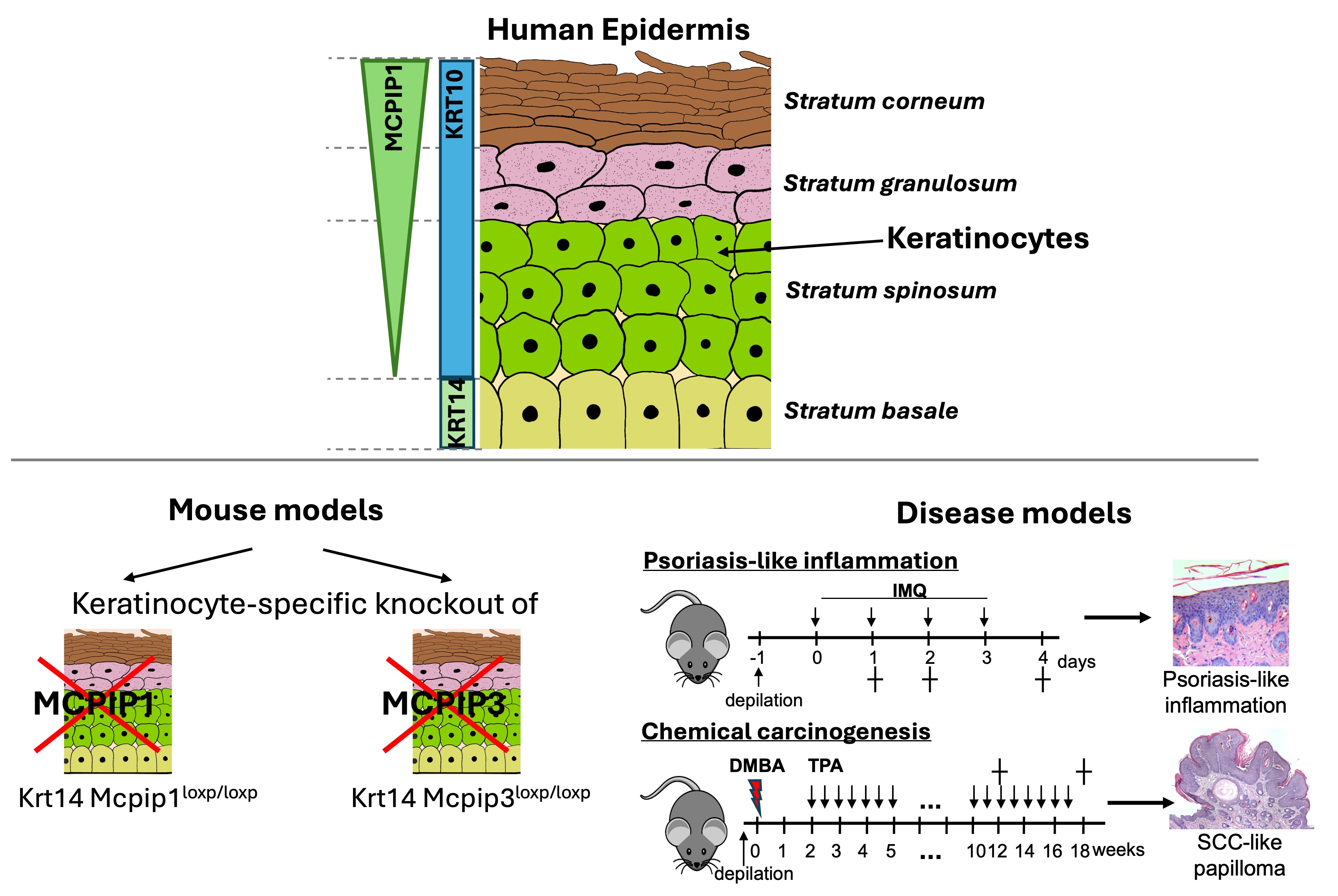
Within the framework of SONATA project (2022/47/D/NZ3/01654), we have recently demonstrated that epidermis-specific deletion of MCPIP3 leads to increased keratinocyte proliferation and disturbed epidermal differentiation, without inducing skin inflammation, in contrast to deletion of MCPIP1 [4]. One of the underlying mechanisms is related to the regulation by MCPIP3 transcripts of genes associated with the cell cycle regulation, including that of cyclin B1, as well as its direct interaction with proteins involved in keratinocyte proliferation, keratin-14 and 14-3-3 proteins [5]. We are currently investigating in greater detail the molecular pathways underlying MCPIP3 activity in both homeostatic conditions and skin disease models.
In turn, within the OPUS project (2021/41/B/NZ5/03601), we are comparing the effects of epidermal-specific deletion of MCPIP1 and MCPIP3 on the development of chemically induced skin cancer, as well as the molecular mechanisms associated with global changes in coding and non-coding RNA profiles. We have already demonstrated that deletion of MCPIP1 leads to alterations in the miRNA–mRNA network, including miR-223-3p and miR-376c-3p levels, contributing to tumor development [6]. Currently, the impact of MCPIP3 deletion on processes associated with skin cancer development is being investigated.
[1] Konieczny P, Lichawska-Cieslar A, Kwiecinska P, Cichy J, Pietrzycka R, Szukala W, Declercq W, Devos M, Paziewska A, Rumienczyk I, Kulecka M, Mikula M, Fu M, Borowczyk J, Santamaria-Babí LF, Jura J. Keratinocyte-specific ablation of Mcpip1 impairs skin integrity and promotes local and systemic inflammation. J Mol Med (Berl). 2019; 97, 1669-1684. PubMed PMID: 31786670
[2] Lichawska-Cieslar A, Konieczny P, Szukala W, Declercq W, Fu M, Jura J. Loss of keratinocyte Mcpip1 abruptly activates the IL-23/Th17 and Stat3 pathways in skin inflammation. Biochim Biophys Acta Mol Cell Res. 2021;1868, 118866. PubMed PMID: 33007332
[3] Szukala W, Lichawska-Cieslar A, Pietrzycka R, Kulecka M, Rumienczyk I, Mikula M, Chlebicka I, Konieczny P, Dziedzic K, Szepietowski JC, Fontemaggi G, Rys J, Jura J. Loss of epidermal MCPIP1 is associated with aggressive squamous cell carcinoma. J Exp Clin Cancer Res. 2021; 40, 391. PubMed PMID: 34903245
[4] Lichawska-Cieslar A, Szukala W, Pilat P, Eckhart L, Szepietowski JC, Jura J. MCPIP3 orchestrates the balance of epidermal proliferation and differentiation. Cell Commun Signal. 2025 Apr 8;23(1):175. doi: 10.1186/s12964-025-02184-1. PMID: 40200325; PMCID: PMC11980240.
[5] Lichawska-Cieslar A, Szukala W, Eckhart L, Jura J. MCPIP3/Regnase-3 binds 14-3-3 proteins and contributes to the regulation of the cell cycle in human immortalized keratinocytes. Sci Rep. 2025 Sep 26;15(1):33222. doi: 10.1038/s41598-025-18468-y. PMID: 41006702; PMCID: PMC12475053.
[6] Lichawska-Cieslar A, Szukala W, Ylla G, Machaj G, Ploskonka F, Chlebicka I, Szepietowski JC, Jura J. MCPIP1 modulates the miRNA‒mRNA landscape in keratinocyte carcinomas. J Exp Clin Cancer Res. 2024 Oct 21;43(1):290. doi: 10.1186/s13046-024-03211-8. PMID: 39428471; PMCID: PMC11492624.
